
AI Needs a Pilot: Why Marketing Automation Fails Without Human Judgment
Executive summary
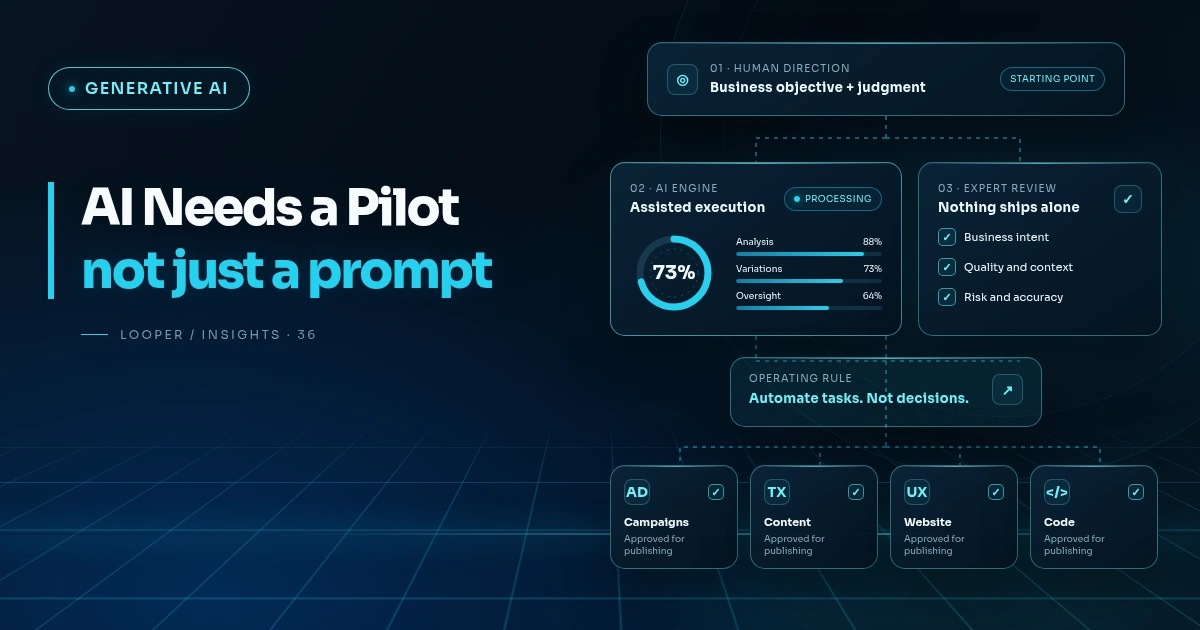
AI multiplies whatever the person directing it brings. In expert hands, it speeds up the work and improves results. Without that direction, it produces confident-looking mistakes, faster. That applies across marketing and development: automated campaigns optimizing toward the wrong goal, content that sounds like everyone else's, websites that work but do not rank, code that runs but has issues nobody reviewed. The useful question is not whether to use AI, but who is flying it: who sets the objective, supplies the context, reviews the output and owns the outcome.
The pitch and the fine print
Every week brings a new tool promising to do on its own what used to take a team: build a website from a sentence, run ad campaigns, write the month's content, analyze the data and tell you what to do. The largest ad platforms now include assistants that diagnose accounts and propose one-click optimizations, such as Ads Advisor in Google Ads and Amazon's campaign and creative agents.
The tools are real and useful. We use them every day. But there is a gap between what a tool can do and what it does when nobody is directing it. The fine print on every one of those promises is the same: the result depends on the instructions, the context and the review. In other words, on someone who knows what they are doing.
Why AI needs a pilot
There are three underlying reasons, and none of them will disappear with the next model release:
It optimizes for what you ask, not what you need. A campaign algorithm trained to generate leads will generate leads, even if none become customers. AI does not question the objective; it executes it.
Its mistakes sound convincing. Models produce the most probable answer, not the true one. An invented data point, a plausible but wrong setting or a security flaw in generated code do not announce themselves. Only someone with domain knowledge catches them.
It does not know your business. It knows what is public. It does not know your margins, customers, history, constraints or what sets you apart. Without that context, it produces what it would produce for anyone.
What happens in each area without expert direction
| Area | What AI does well | What needs human judgment | Risk without oversight |
|---|---|---|---|
| Paid media | Bidding, targeting, ad variations | Conversion goals, exclusions, budget, message | Efficiently optimizing toward the wrong outcome |
| SEO and GEO | Research, drafts, content analysis | Topic priorities, proprietary data, authority | Generic content that neither ranks nor gets cited |
| Content and social | Volume, repurposing, ideas | Brand voice, editorial judgment, timing | Brands that all sound the same |
| Websites | Initial structure, layout, base copy | Architecture, performance, technical SEO, identity | Sites that look good but underperform |
| Development | Code, tests, documentation | Architecture, security, maintainability | Problems that surface months later |
| Analytics | Spotting anomalies, summarizing data | Explaining causes and deciding actions | Sound conclusions drawn from bad data |
In marketing
Automated campaigns are the clearest example. Performance Max, Advantage+ and the new platform assistants make bidding and targeting decisions better than a person adjusting by hand. But they decide within a framework someone defined: what counts as a conversion, what is excluded, how much is spent and what message is communicated. If that framework is wrong, automation amplifies the error.
Content follows the same pattern. AI writes quickly and fluently, but if nobody contributes proprietary data, real experience and a defined voice, the output is interchangeable with any competitor's. Interchangeable content does not rank, does not get cited by AI engines and does not build trust.
In websites and development
Today you can have a working site in minutes or generate the code for a new feature from a prompt. That is a big leap forward. But a site that loads is not the same as a site that ranks, converts and can be maintained. Structure, performance, technical SEO, security and visual identity still depend on decisions the tool does not make on its own.
What well-piloted AI looks like
In practice, working with AI responsibly comes down to four moments, each with a clear owner:
Set the objective: what you want to achieve and how it will be measured. AI cannot decide this for you.
Provide context: business data, constraints, examples of what works and what does not, the brand voice.
Review the output: someone with expertise validates it before it is published, configured or deployed.
Own the outcome: measure the impact and correct course. Accountability is never delegated to the tool.
At Looper, we use AI in every area we work in. The difference is the team flying it: specialists in each channel who know what to ask for, what to check and what never to delegate.
Common mistakes
Confusing speed with results. Producing twice as much is pointless if it does not work.
Delegating the objective. Accepting automated recommendations without asking whether they serve the business.
Publishing without review. The cost of a public mistake outweighs any time saved.
Using AI for what makes you different. Your judgment and experience are exactly what the model lacks.
Feeding sensitive data into tools without a policy. Customer and commercial data need clear rules.
Where to start
List the AI tools your team and vendors already use, and for what.
For each one, identify who sets the objective and who reviews the output. If the answer is nobody, start there.
Review the automated recommendations applied to your ad accounts over the last three months.
Define what company information can be entered into external tools.
Measure quality, not just time saved, for every automated task.
If you work with an agency, ask how it uses AI and who reviews what gets published.
Is there an expert team behind the AI in your marketing? At Looper, we pair the latest AI tools with specialists in paid media, SEO, GEO and automation who direct and review every step. Book a diagnostic
Frequently asked questions
Can AI replace a marketing or development team?
AI can replace tasks, not the judgment that directs them. It executes extremely well when someone defines what to do, with what context and to what standard. Without that direction, it produces plausible results that may be wrong. The teams that get the most out of AI are not smaller teams; they are expert teams that produce more, faster.
What does “human-in-the-loop” mean in marketing?
It means a person with real expertise sets the objective, provides business context, reviews the output before it reaches the market and owns the decision. It is not about supervising every click; it is about directing the work and validating what matters.
Why do AI mistakes look correct?
Models generate the most probable answer, not the true one. That makes their errors convincing: an invented statistic, a configuration that looks right but is not, code that runs but contains a vulnerability. Catching them takes someone who knows the subject.
Do automated Google and Meta campaigns still need oversight?
Yes. Platforms optimize very well toward the goal they are given, but they do not know whether that goal is right for your business. If they are trained on form fills instead of customers, or if irrelevant searches are not excluded, the algorithm will pursue exactly that with great efficiency. Direction is still a human job.
Is AI-generated code safe to ship?
It can be, as long as someone who understands the code reviews it. AI speeds up development dramatically, but it can introduce security, performance or maintainability issues that are not visible at first glance. A site that works is not the same as a site that is well built.
Does using AI reduce marketing costs?
It reduces the cost of producing, not necessarily the cost of getting results. If AI is used to produce more without a clear strategy, the savings turn into volume without impact. Used well, it frees an expert team to spend more time on the decisions that drive results.
What should I expect from an agency that uses AI?
Clear processes for what is automated and what is not, human review of everything published or configured, real expertise in the channels it manages and transparency about how it uses the tools. An agency that promises results because it uses AI, without explaining who makes the decisions, is selling the tool rather than the judgment.
Where should a company start with AI in marketing?
Pick two or three repetitive tasks with easy-to-verify outputs, assign a reviewer for each and measure quality as well as time saved. Then define which company information can be entered into external tools and which cannot.