
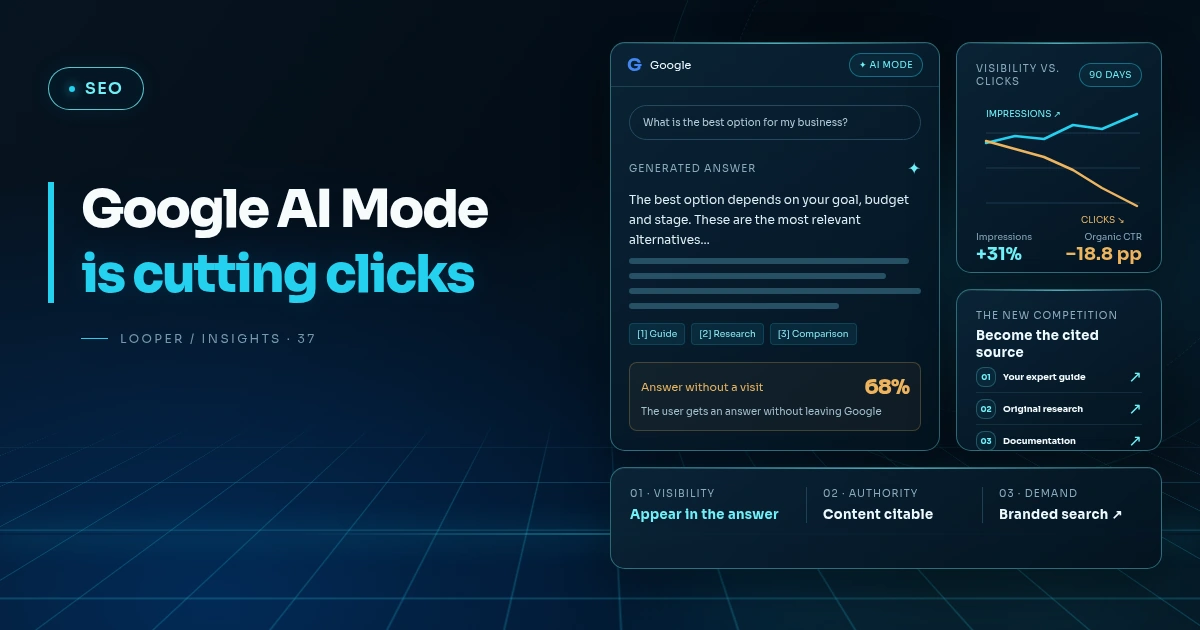
Google's AI Mode Is Cutting Clicks: What U.S. Businesses Should Do Now
Executive summary
A field experiment by researchers at the University of Pennsylvania and Northeastern University, reported in November 2026, found that U.S. users who switched to Google's AI Mode clicked through to external websites 18.8 percentage points less, and clicked ads 42.7 percentage points less. It is a preprint, but it confirms a trend already visible with AI Overviews. For U.S. businesses, the right response is not to panic about traffic. It is to change three things: measure visibility and conversions alongside clicks, work to become the source AI engines cite, and focus content on what still earns valuable visits.
What the study found
The experiment followed 1,100 U.S. users for three baseline days and then for a week in their assigned condition: some kept using traditional Google search, others switched to AI Mode. The results most relevant to businesses:
| Metric | Difference for AI Mode users |
|---|---|
| Clicks to external websites | −18.8 percentage points |
| Ad clicks | −42.7 percentage points |
| Likelihood of using another search engine | +11.2 percentage points |
| Visits to news sites, Reddit and Wikipedia | Lower |
Two caveats apply. It is a preprint that has not yet been peer reviewed, and the sample skews younger and more college-educated. But it is not an isolated finding: an earlier study by Saharsh Agarwal and Ananya Sen found that AI Overviews cut outbound organic clicks by 39.8% on searches where they appeared. Different methods, same direction.
Why this changes how you measure
For two decades, Google visibility was measured in clicks. If you ranked but did not get the click, the problem was your title or your position. Generated answers break that logic: your brand can be the source of the answer, users can read your information and be satisfied, and you get no session at all.
That does not make visibility worthless. It means clicks are no longer the only signal. A company that watches only organic traffic will see declining numbers and may make the wrong call: cutting content investment just as that content is what AI engines are using to answer.
What to do now: five moves
1. Separate sessions from business outcomes
First, understand what traffic you are losing. Many searches now answered without a click were informational and converted poorly. If sessions drop but leads, sales and branded search hold, the business impact is smaller than it looks. If conversions fall, act quickly.
2. Track your presence in AI answers
Build a fixed set of 30 to 50 questions about your category and run them monthly in AI Mode, ChatGPT, Gemini and Perplexity. Record whether your brand appears, how it is described and who appears instead. It is the new equivalent of rank tracking.
3. Become the source that gets cited
Generative engines favor sources that answer clearly, provide specific information and are corroborated elsewhere. That means proprietary data, direct answers, clear structure, well-implemented structured data and mentions on reputable sites. This is GEO, and it is built on solid SEO.
4. Invest in content people still click
Some content cannot be replaced by a summary: tools, calculators, detailed comparisons, original data, product and service pages with decision-making information, and case studies. Branded and high-intent commercial searches still drive visits. Concentrate effort there.
5. Reduce dependence on a single channel
If search becomes a smaller source of visits, owned audiences, email, community and brand demand become more important. Brands with strong recall get direct searches, which are the least affected.
What to measure from now on
| Before | Now, in addition | Why |
|---|---|---|
| Organic clicks | Impressions and position in Search Console | Visibility exists even without a click |
| Keyword rankings | Presence in AI-generated answers | That is where the shortlist gets decided |
| Total traffic | Organic conversions | Business outcomes matter, not sessions |
| Blog pageviews | Branded search and direct traffic | Signals of brand recall and demand |
Common mistakes
Cutting content because traffic dropped. That content may be exactly what AI uses to mention you.
Measuring only clicks. It hides the visibility you have and the visibility you are losing to competitors.
Producing content that can be summarized in one line. That is the content losing the most visits.
Treating SEO and GEO as separate projects. They share a foundation and work best together.
Ignoring the paid search impact. If ad clicks shift too, budget allocation needs a fresh look.
Where to start
Compare impressions and clicks in Search Console over the last 12 months. If impressions hold and clicks fall, AI is answering on your behalf.
Cross-check that trend against organic conversions.
Build your question set and benchmark your presence in AI assistants.
Identify your 10 pages with the most impressions and rewrite them to answer clearly and add something original.
Plan one asset that cannot be summarized: a tool, a comparison or original data.
Review how much of your demand generation depends on organic search and which channels can balance it.
Is your organic traffic shifting and you want to understand why? At Looper, we run SEO and GEO together so your brand stays visible in search results and in AI-generated answers. Let's talk.
Frequently asked questions
What is Google AI Mode?
AI Mode is Google's search experience in which the main answer is generated by AI in a conversational format rather than presented as a list of links. Users can ask follow-up questions and get complete answers without visiting websites. It is different from AI Overviews, which are generated summaries shown above traditional results.
How much traffic is AI Mode taking from websites?
A field experiment by researchers at the University of Pennsylvania and Northeastern University, reported in November 2026, found that users who switched to AI Mode clicked through to external websites 18.8 percentage points less than with traditional search. It is a preprint that has not been peer reviewed, based on 1,100 U.S. users, but it points in the same direction as earlier research.
Does AI Mode affect paid search too?
According to the same study, ad clicks fell 42.7 percentage points among AI Mode users. That is worth watching closely, because it suggests conversational search changes the dynamics of paid search, not only organic traffic.
Do AI Overviews also reduce clicks?
Yes. An earlier study by Saharsh Agarwal and Ananya Sen found that AI Overviews reduced outbound organic clicks by 39.8% on searches where they appeared. The figures measure different things and are not directly comparable, but both point the same way.
If my organic traffic drops, am I losing customers?
Not necessarily. Many of the searches now answered without a click were informational and converted poorly. Track conversions, inquiries and branded search, not just sessions. Traffic can fall while the business holds steady, or the other way around.
Which metrics should we track now?
Impressions and average position in Google Search Console, brand presence in AI-generated answers, branded search volume, organic conversions and direct traffic. Clicks still matter, but they are no longer enough on their own to measure visibility.
How do you show up in AI Mode answers?
With content that answers clearly and specifically, offers information not available elsewhere, uses well-implemented structured data and is supported by mentions on reputable third-party sources. This is what is known as GEO (generative engine optimization), and it builds on a strong SEO foundation.
Is SEO still worth investing in?
Yes, with a different objective. SEO is no longer just about earning clicks; it is about being the source engines use to answer, and capturing the searches that still drive visits, which tend to be the ones with the highest commercial intent.