
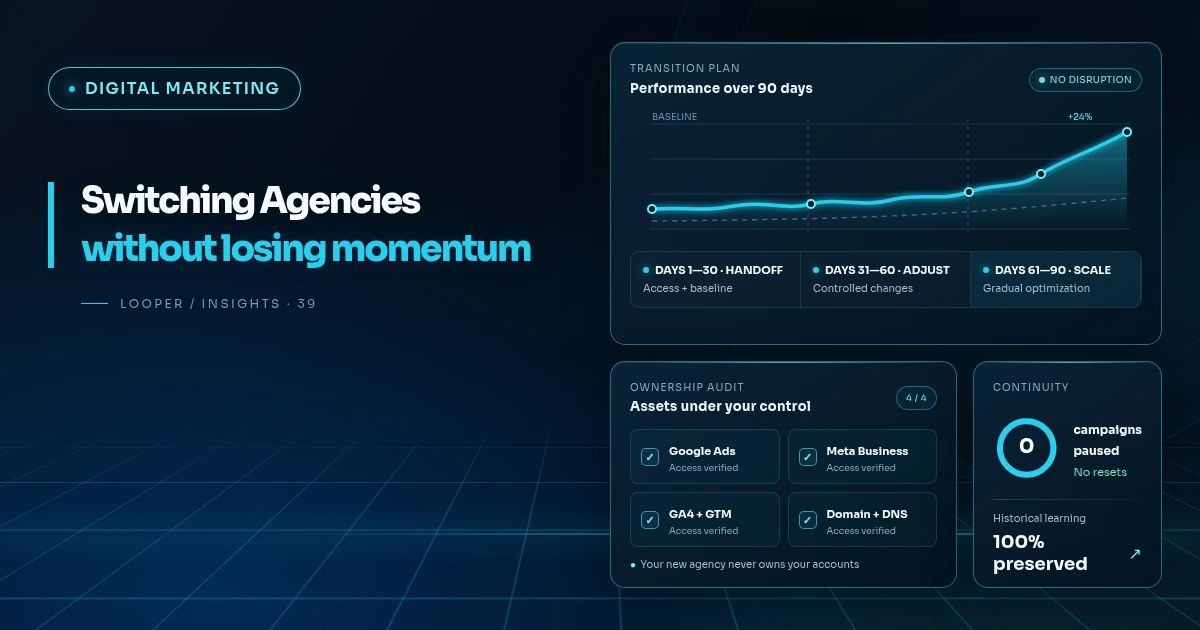
Switching Marketing Agencies Without Losing Momentum: A 90-Day Transition Plan
Executive summary
Changing marketing agencies does not have to cost you results. The performance drops companies fear after a switch rarely come from the new agency itself. They come from accounts the company did not own, from restructuring everything at once and from having no baseline to compare against. A well-run transition follows three phases over 90 days: secure ownership and access, audit without touching what works, and then optimize gradually and measurably.
Why companies delay a switch they have already decided on
The decision to change agencies is often made months before it happens. The delay is rarely doubt about whether to switch. It is fear of what happens in between: campaigns tanking, history disappearing, organic traffic dropping or the outgoing agency refusing to cooperate.
That fear is reasonable; everyone knows a transition that went badly. But look closely at those cases and the same three mistakes show up every time. All three are avoidable.
The three mistakes that cost momentum
The company did not own its accounts. The previous agency created ad accounts or analytics properties under its own manager account. When it leaves, it takes the history, audiences and conversion data with it.
The new agency changed everything at once. Restructuring campaigns, objectives and budgets in week one resets platform learning. Performance drops, and nobody can tell whether it was the agency change or the changes themselves.
There was no baseline. Without documented pre-switch metrics, by month two nobody can say for sure whether results improved or declined. The debate turns into opinions.
Before you announce the switch: the ownership audit
The first step does not involve any agency. Quietly confirm that every digital asset is in your company's name. If something is not, fix it before announcing the change, while the relationship with your current agency is still in good standing.
| Asset | What to check | If it is not in your name |
|---|---|---|
| Google Ads | The account belongs to your organization; the agency accesses it through its manager account | Request an ownership transfer before giving notice |
| Meta Business Manager | The business portfolio, ad account and pixel are yours | Request transfer or set up your own and migrate |
| Google Analytics and Tag Manager | You have admin rights, not just user access | Request admin permissions |
| Search Console | You are a verified owner | Verify ownership through your domain |
| Domain and hosting | Registered to your company | Transfer before any other step |
| Email platform and lists | Account ownership and the ability to export contacts | Export your list and regularize the account |
| Creative and source files | Your contract assigns you the rights and you have the originals | Request editable source files |
The 90-day plan
Days 1–30: handoff and audit, no major changes
The goal of month one is understanding, not changing. The incoming agency receives access, documentation and, if negotiated, a period of overlap with the outgoing team. It then audits every channel: what works, what does not, what is misconfigured and where the risks are.
At the same time, document the baseline: cost per acquisition, conversion volume, organic traffic, return by channel and any other metric your company uses to make decisions. That is the benchmark for everything that follows. The only fixes in this period are critical errors: broken conversion tracking, obvious wasted spend, campaigns that should be paused.
Days 31–60: first changes, one at a time
With the audit approved, the prioritized change plan begins. Change one variable at a time per channel and wait for data before moving on. Each change stays measurable and reversible. Leave profitable campaigns for last; start where performance is clearly weak and the upside is high.
Days 61–90: optimization and first review
With full control and early changes validated, the agency can take on structural work if needed: new campaigns, budget reallocation across channels, larger creative tests. At the end of the period, run a formal review against the baseline. The question is not yet whether the new agency is great; it is whether the transition finished without losing ground and is heading in the right direction.
What to ask the incoming agency for in the first weeks
A written audit with findings prioritized by impact, not just a list of improvements.
A dated change plan stating what will change, when and which metric will judge each change.
A documented baseline and a dashboard tracking progress against it.
A risk list covering what could go wrong during the transition and how it will be mitigated.
Common mistakes
Giving notice before securing your assets. That is when you will get the least cooperation.
Switching during peak season. Any issue is amplified when you sell the most.
Judging the new agency in month one. That month is for learning, not results.
Changing the website without a migration plan. If the switch includes site changes, SEO needs its own plan.
Leaving cooperation out of the contract. You cannot count on the outgoing agency's goodwill.
Where to start
Run the ownership audit using the table above, asset by asset.
Move any asset not in your company's name before giving notice.
Document six months of baseline metrics by channel.
Pick a start date away from your peak sales periods.
Agree with the outgoing agency on documentation handoff and, ideally, two to four weeks of overlap.
Ask the incoming agency for its written audit and 90-day plan before it changes anything.
Planning an agency switch and want to do it without the risk? At Looper, we run transitions with a pre-switch audit, a documented baseline and a 90-day plan across paid media, SEO and GEO. Plan my transition
Frequently asked questions
Will I lose my campaign history if I switch agencies?
Not if the ad accounts belong to your company. Campaign history lives in the account, not with the agency; what changes is who has access. If your current agency created the accounts under its own manager account or business profile and keeps them, the history goes with it. That is why the first step, before announcing anything, is to confirm who owns each account.
How long does an agency transition take?
Plan for 60 to 90 days until the new agency has full control and performance has stabilized. The first two to four weeks cover access transfer, auditing and documentation; the rest is gradual optimization. Transitions that try to change everything in week one are the ones that lose the most momentum.
Should the outgoing and incoming agencies overlap?
Yes, when possible. Two to four weeks of overlap lets the outgoing agency hand over documentation, explain active decisions and answer questions. Build it into your termination terms, because not every outgoing agency has an incentive to cooperate.
Which assets should my company own?
Google Ads, Meta Business Manager, LinkedIn and TikTok ad accounts; Google Analytics and Tag Manager; Search Console; pixels and conversion APIs; your domain and hosting; your email platform and lists; creative files and source assets; and CRM access. The agency should have partner or user access, never ownership.
Do campaigns need to be rebuilt when switching agencies?
No. Restructuring everything at once resets the platforms' learning and usually causes weeks of underperformance. Keep what works, audit with data and change one variable at a time so each change can be measured and reversed if needed.
How do I prevent a performance dip during the switch?
Three rules: do not touch the structure of profitable campaigns in the first month, keep budgets steady during the handoff and document a baseline before the switch so you can compare. A minor dip in the first weeks can be normal; a sharp drop almost always traces back to abrupt changes.
What contract terms protect me when changing agencies?
Clear ownership of accounts, data and creative work; a defined notice period; an obligation to transfer access and documentation; a cooperation period during handoff; and the return or deletion of your data. Review these terms with every agency before signing, not when you are on your way out.
When is the best time to switch?
Away from your peak sales periods. Switching right before Black Friday, a product launch or your strongest season multiplies the risk. Ideally, start the transition during a stable demand period so the new agency reaches peak season with full control.