
Why Every Brand's Social Feed Looks the Same Now
Executive summary
AI made producing social content faster and cheaper than ever, and as a result many brands now publish the same thing: the same hooks, the same structures, the same polished visuals. Audiences notice. A 2026 Copenhagen Business School study found that, for identical content, an AI-generated label reduced emotional engagement by up to 46 percentage points. The answer is not to stop using AI. It is to use it with a defined brand voice, original ideas and a human editor who decides what goes out.
The interchangeable feed
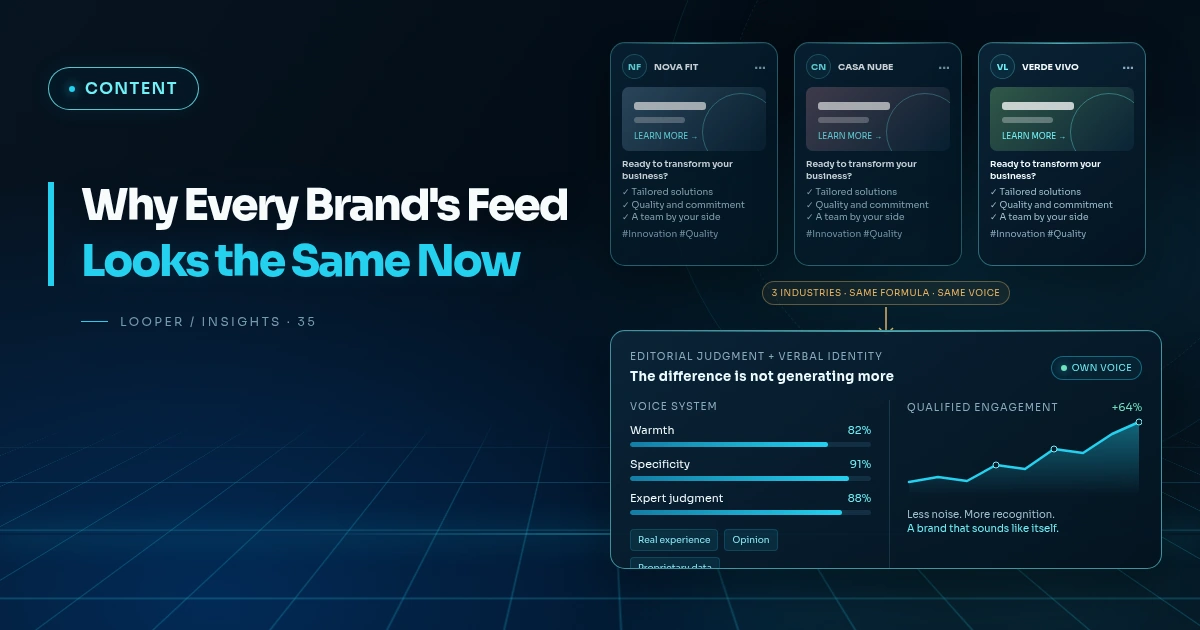
Scroll through brand accounts across completely different industries and a pattern emerges. A hook that opens with a rhetorical question or “At [brand], we believe…” A list of benefits with identical cadence. An inspirational sign-off. A glossy image with soft gradients and people or places that do not exist. Swap the logo and the product, and the rest is the same.
It is not a coincidence. Brands are using the same tools with similar prompts, and AI models tend to produce the most probable result. Without someone contributing a point of view, output converges toward the average. And the average is forgettable.
What the data shows
The Copenhagen Business School study, published in 2026 in the journal Electronic Markets, ran two experiments with nearly 700 participants who saw identical posts labeled as human-made, AI-enhanced or AI-generated. Because the content was the same, the only variable was the label.
| Content type | AI-enhanced | AI-generated |
|---|---|---|
| Emotional content | −24 points in emotional engagement | −46 points in emotional engagement |
| Informational content | −13 points | −27 points |
Two useful conclusions. First, the penalty is largest exactly where brands are trying to build connection: emotional content. Second, there is a clear difference between using AI to improve human-made work and handing everything to the tool. For AI-enhanced content, disclosing AI use after people saw the post reduced part of the negative effect; for fully AI-generated content, it did not.
Why it happens: four causes
1. No written brand voice
Many brands have an intuitive tone that lives in the head of whoever used to post. When production moves to a tool, that tone does not travel, because it was never written down. The tool fills the gap with its own style, which is everyone's style.
2. Asking AI for the what, not just the how
Asking a tool to adapt your idea to different formats is one thing. Asking it to decide what to talk about this week is another. In the second case, the brand stops having opinions and starts posting what anyone would post.
3. Optimizing for volume
When production is cheap, the temptation is to post more. But more interchangeable posts do not add differentiation; they dilute it.
4. No editorial review
The draft gets published with light edits because it sounds good. Sounding good is exactly what models do. Sounding like your brand is something else.
How to use AI on social without losing your identity
Write down your brand voice. Words you use and avoid, tone, topics you have opinions on and real examples of posts that represent you. It is the input that gives everything AI produces an identity.
Ideas and opinions come from the brand. Your data, your team's experience, your take on the industry. AI helps shape them.
Show what is real. Real people, processes, products and places build a kind of trust a perfect generic image cannot.
Use AI for what it does well. Format adaptations, variations, captions, first drafts and idea exploration.
Every post goes through a person. Someone who edits, not someone who approves in two seconds.
Measure what matters. Comments, saves, shares, DMs and branded search, not just reach.
Common mistakes
Handing the entire content calendar to a tool. The brand stops having anything of its own to say.
Using generated images for everything. The aesthetic is now recognizable and reads as inauthentic.
Posting more to compensate. Volume does not replace differentiation.
No voice guide. Without one, AI imposes its own style.
Measuring only reach. Content that gets seen but not remembered does not build a brand.
Where to start
Put your last 12 posts next to those of three competitors. Cover the logos and see if you can tell them apart.
Write a one-page voice guide with real examples.
List five topics where your brand has a genuine opinion or proprietary data.
Decide which tasks AI handles in your content process and which it does not.
Make editorial review mandatory before anything is published.
For one month, track comments, saves and DMs alongside reach.
Does your brand stand out in the feed, or blend in? At Looper, we run social media with AI and with a team that defines your voice, shapes the ideas and edits every piece. Let's talk.
Frequently asked questions
Is it a mistake to use AI for brand social media?
No. AI is genuinely useful for ideation, repurposing formats, producing variations and speeding up editing. The problem starts when it replaces editorial judgment: what to say, how to say it and why. That is when brands start to sound the same.
Why do so many brand posts look alike?
Many brands use the same tools with similar prompts, and AI models tend to produce the most probable output: the same hooks, the same sentence structures, the same polished visual style. Without a defined brand voice and someone applying it, content converges toward the average.
Can audiences tell when a post is AI-generated?
Increasingly, yes, and not only because of platform labels. Certain copy patterns, image aesthetics and stock phrases have become recognizable. A 2026 Copenhagen Business School study found that, for identical content, an AI-generated label reduced emotional engagement by up to 46 percentage points.
Do AI content labels hurt performance?
According to the same study, yes. Emotional engagement dropped when content was labeled as AI-enhanced or AI-generated, with a larger drop for emotional content than for informational content. For AI-enhanced content, disclosing after viewing reduced part of the effect; for fully AI-generated content, timing made no difference.
What is a brand voice and why does it matter now?
It is the recognizable way a brand expresses itself: vocabulary, tone, topics, opinions and rhythm. It always mattered, but now it is what separates a brand from the average content AI tools produce. A documented voice is also what lets you use AI without losing your identity.
How do you use AI for social without losing your identity?
With a written voice guide, examples of what is and is not on-brand, a defined set of topics and points of view, and a human editor who reworks every draft before it goes live. AI accelerates production; editorial judgment decides what gets published.
Does posting more often make up for lower-quality content?
Generally, no. More content that looks like everyone else's adds volume, not differentiation or trust. Fewer pieces with a real point of view usually outperform a high volume of interchangeable posts.
What should I ask whoever manages our social media?
How they use AI, who reviews what gets published, how the brand voice is applied, what share of the content comes from your company's own knowledge and how they measure results beyond reach.